What You Don’t Know About Bordeaux
First, when someone asks, “Do you drink?” there is, in my experience, an undertone to the question.
What they really mean is: Do you get drunk?
With Bordeaux (and wine in general), can wine be something else entirely for our generation? The 38 - 48 year old set.
It’s slow drinking.
So when someone asks you after reading this article, “Do you drink?”
The answer is simple:
“No. I drink Bordeaux.”
I had my first Bordeaux on Valentine’s Day 2026, a Château Montrose 2022, I did keep the bottle (actually it’s in my backyard somewhere), don’t ask.
The first thing to understand about Bordeaux is that it revolves around two ideas: the château, and the Left Bank vs. Right Bank. More on that in a moment.
My first sip was in the same category as a few other moments in life: the first time I smoked weed, the first time I tasted real French butter, the first kiss.
Moments where a sense you didn’t know existed suddenly wakes up.
The taste was roses and butter.
Yes, roses. A slight bitterness like rose petals, but also the smell of roses, the color of garden roses, and the taste of high-end butter. Then something happened in the finish. Fireworks the smell, almost like flavor pop rocks exploding after the smell.
I immediately thought:
Wow.
Now you need to know something about me.
My current co-founder and I grew up during Washington State’s wine boom in the early 2000s. In fact, the first company we ever sold was wine club software called BuyersVine.
From our limited perspective at the time, two guys in our twenties, nothing could compete with Washington wine.
Of course we were also in college.
We drank wine the way college kids drink wine.
Then life evolved. Martini years. Manhattan years. Sipping tequila. Beer phases. Wine and drinking in general took a back seat somewhere in my late thirties and definitely into my forties.
Drinking became something different.
An occasion.
A pairing.
A hideout on vacation.
Not a random Friday night habit.
So when the first sips of Montrose rolled over my tongue and the pop rocks of flavor expanded my consciousness, I did what everyone does in 2026.
I went straight to YouTube.
Bordeaux, both a city and a wine region in southwest France, has been making wine since the 1600s.
Yet the thing you will read about most is the 1855 Bordeaux Classification, created under Napoleon III.
Not the conquering Napoleon. A relative. *that Napoleon preferred Burgundy's.
For the Paris Exposition, wine merchants were asked to rank the region’s top wines based largely on price and reputation at the time.
They created five levels:
First Growth
Second Growth
Third Growth
Fourth Growth
Fifth Growth
The First Growths include names you’ve probably seen on wine lists:
Château Margaux
Château Latour
Château Haut‑Brion
Château Mouton Rothschild
These are the bottles you see on a wine list for $1,000+ and wonder:
Who orders these?
I’ll tell you who.
First, someone who truly knows Bordeaux.
Second, someone remembering an occasion and the people around the table.
Third, the show-off who doesn’t know any better.
Those are the types.
Back to Bordeaux.
There are two sides of the river, technically an estuary where the ocean flows in and out.
The Left Bank and the Right Bank.
Bordeaux is essentially dominated by two grapes: Cabernet Sauvignon and Merlot.
On the Left Bank, Cabernet dominates.
On the Right Bank, Merlot dominates.
Almost all Bordeaux wines are blends, often including Cabernet Franc, Petit Verdot, or Malbec alongside the dominant grape.
Worth mentioning that 1855 classification again.
In my personal opinion, the classification wasn’t really about quality.
It was about price.
Price created prestige. Prestige created demand. Demand created money.
And money allowed the First Growth châteaux to keep investing in their vineyards and winemaking for the next 170 years.
Meanwhile many Second and Third Growth estates became permanently branded as “below them,” even if their wines were sometimes just as good.
Wine history is part agriculture, part culture, and part marketing.
Today Bordeaux is everywhere.
On restaurant lists.
In wine shops.
Even at Safeway.
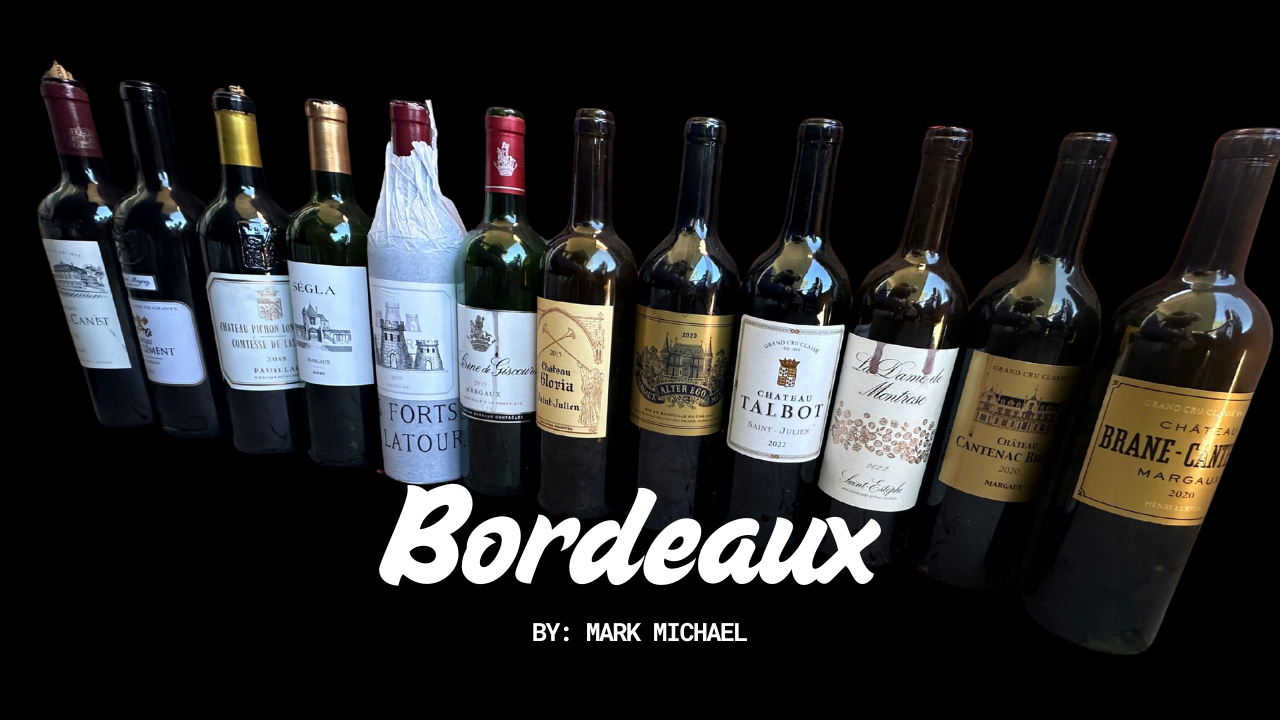
And to be honest, a lot of it is just… fine *see image above.
Because Bordeaux is enormous.
Thousands of producers. Thousands of vineyards.
In theory, even though the appellations (or what we call in Washington AVAs) are unique to each château producing wine, they are so geographically so close that distinguishing them can sometimes feel impossible.
Or maybe that’s the art.
Some Bordeaux I’ve tried aren’t even about the taste.
They’re about the smell.
And smell, if you don’t know, is the sense most directly tied to memory.
Some wines take me back to childhood on a farm in California’s Central Valley.
Others remind me of hot days with freshly cut grass during ninth grade growing up in eastern Washington summers.
Some Bordeaux are like a time machine.
Or a genie lamp.
One sip and suddenly you’re back inside a full nostalgia moment.
Here are two more things about Bordeaux.
First: slow drinking.
Second: the cost keeps it from becoming a habit *I think
A decent bottle of Bordeaux often starts around $100.
Which means it’s rarely casual.
It becomes something intentional.
As I said at the beginning, drinking doesn’t have to mean drinking.
Drinking can be slow enjoyment.
An education about a foreign land.
A moment shared with people that will never be repeated in exactly the same way again.
Last year when traveling to Europe, headlines said French wine was being dumped due to overproduction and declining consumption.
Now in 2026 the headlines say alcohol consumption across the board is down.
But what if slow drinking is exactly what brings wine back for millennials?
Not boozy tastings.
Not wine bags from college.
But a deeper curiosity.
A sense of sophistication.
A willingness to explore the Mecca of wine, its tradition, its geography, its stories and to experience the art of something crafted inside a bottle.
A Bordeaux.
###
Side note.
My dad also got on the Bordeaux train when he wasn’t feeling well (a minor cold)...here is his words…
“Bordeaux is healing.”
Maybe he wasn’t entirely wrong.
Because sometimes a glass of Bordeaux isn’t just a drink.
It’s a memory.
A place.
A moment.
And if you’re lucky, it’s a small reminder that the best things in life are meant to be enjoyed slowly.
This week in our living room Washington wine vesus Bordeaux.